
Perspective was the original sin of western painting
By Lameah Nayeem
In Renaissance art, the ambiguity of death is represented as transcendent of linear sight. Holbein, Claesz, and Piola harness distortion to represent the abstract, bridging our observable and rational reality in two-dimensions.
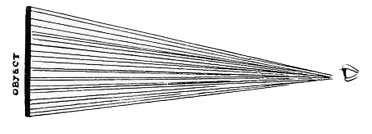
“Perspective was the original sin of Western painting,” identifies Bazin centuries after the reign of geometry and perspectival theory, which indicated a technique of graphic representation, in the Renaissance. When looking back at a handful of Renaissance painters including Hans Holbein, Pieter Claesz, and Domenico Piola, you can observe a sense of skepticism that existed in the pursuit of recreating reality in pictures. This is especially relevant when attempting to represent abstract concepts that do not easily negotiate the confines of two-dimensional painting, particularly the ambiguity of death in the Renaissance imagination. Throughout this period, artists wrestled with the conflict between naturalist perspectives, that espoused that nature is our observable reality and there is nothing beyond, and moral anxieties. Distortion then became a powerful tool to embody what was beyond. Suddenly, subverted perspectives on the canvas became a bridge to understanding the metaphysical concerns surrounding the state of death and incorporeality of the soul.
I
RATIONALITY AND SIGHT
Perspectival theory, coinciding with the rise in efforts to underpin Renaissance art with a mathematical basis, was manipulated to bridge our rational reality with the ambiguity of death, resulting in a representation of this ambiguity as transcendent of linear sight. Linear perspective was crucial to Renaissance painting as it was harnessed to visualise the natural world in as close likeness as possible in two-dimensions. René Descartes posits that the process of compressing the three-dimensional world as observed through the eye as a two-dimensional picture stems from an understanding of the world itself being constituted of several images, both real and mental. We observe and consume the observable world from a single vantage point. The portrait and still-life genre of painting do not challenge the optics of the viewer in any immediate way, nor does it attempt to negotiate the geometric integrity of what is being depicted.
Their purpose is simple: to represent the subject as effectively as possible. Holbein’s eponymous ambassadors and Claesz’s assortment of objects obey naturalism, evidenced by both artists’ dedication to proportion, lighting, and scale. When the subject matter itself is representable and known, sight is seen as the locus of knowledge. These perspective pictures created by Holbein and Claesz reduce the world before them — humans and objects — as extended matter that is rational and understood.
However, when the experience of death enters the equation, logic is confused, and so artistic renderings must follow suit. By evading rationalisation as the greatest ambiguity and threat to a discrete human existence, artistic depictions of death must betray perspectival logic to depict its unassailable nature. Death is eclipsed in mystery. Hence, sight is no longer a faithful translator of a spiritual reality when attempting to convey the unknowable and incommunicable.
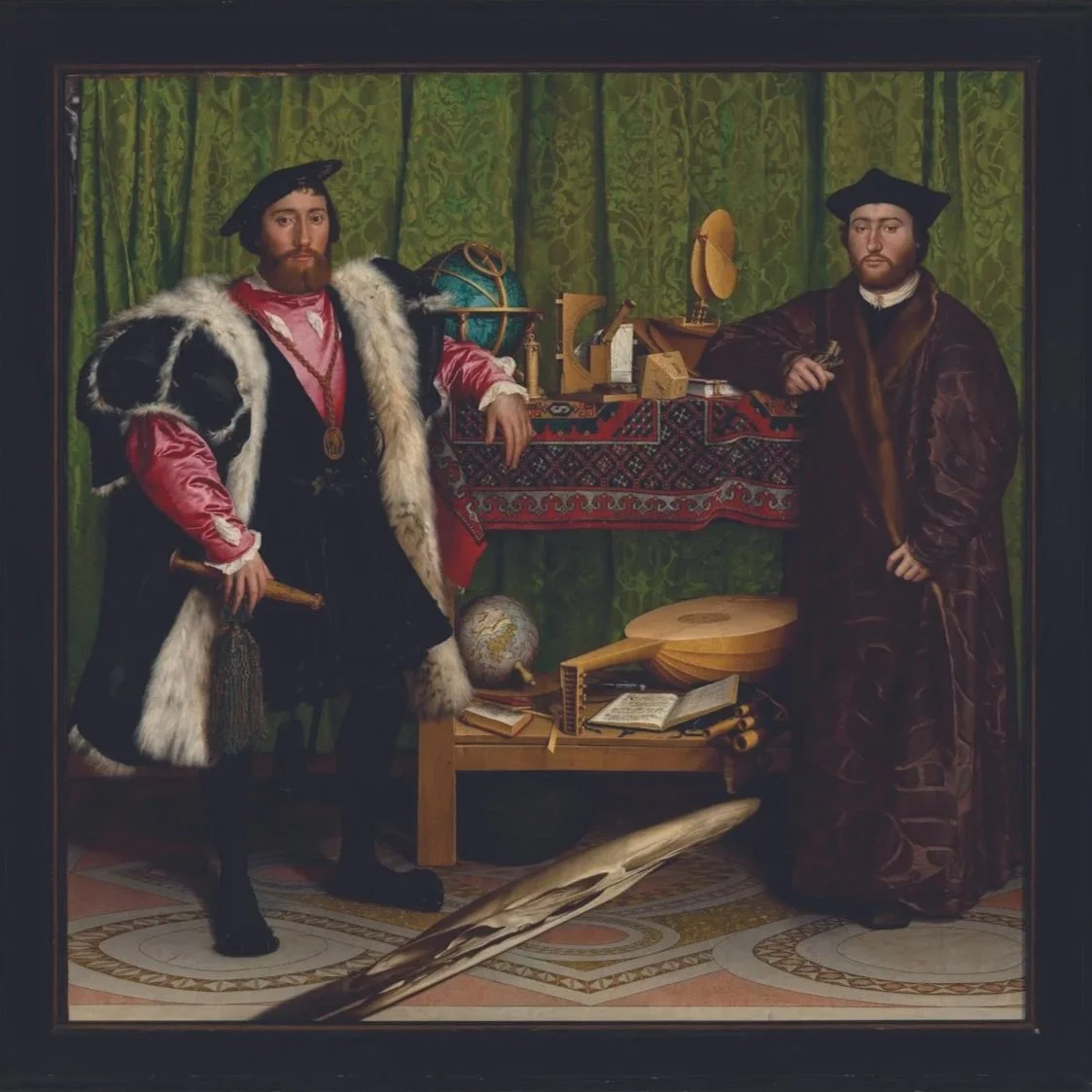
Holbein, Hans, The Ambassadors, oil on oak, 1533, National Gallery, London.
II
AMBIGUITY OF DEATH
Since death is irreconcilable with two-dimensional representations, linear viewing is abandoned. Holbein finds the state of death to be an extrapolation of the human experience that can never be fully rationalised, thus he requires an abstraction of two-dimensional form, namely anamorphosis, to communicate death’s imperviousness to adequate conceptualisation.
Anamorphism is used to deny the usual conventions of ‘looking’ in which an observer views an image frontally from a limited range of viewing angles. The anamorphic projection of an image appears incredibly warped from a linear viewpoint, as seen in The Ambassadors. As the skull is dramatically stretched across the painting’s foreground, it poses a jarring interruption to the otherwise naturalistic depictions of the pavement, desk, and the ambassadors’ proportions and scale. Holbein’s skull is superimposed onto the painting, present and absent at the same time. It obeys the same laws of lighting as everything in the room, though it does not cast a shadow, nor does it interact with any other being or object. Since our mind is incapable of seeing death’s form, Holbein creates a fourth-dimensional space, rendering the skull as immaterial and metaphorical.
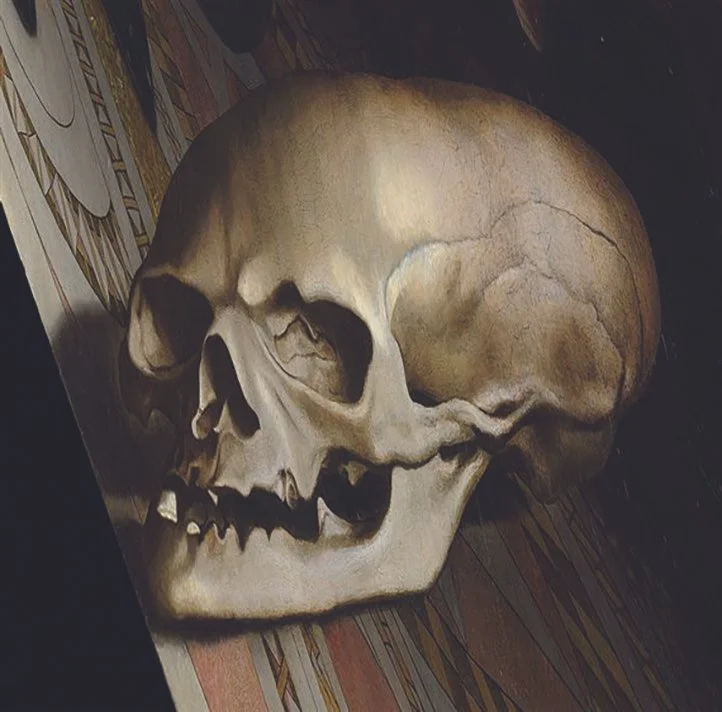
The skull from The Ambassadors as seen from the side.
Anamorphosis’ crucial difference from classical perspective is that an observer becomes self-aware of the viewing process. For Holbein, this effect of self-awareness mirrors the dread one may feel when contemplating the state of death. This existential pondering of death, and the absence of emotion and rational sensibility, was something that plagued the forefront of Holbein’s mind as he was tasked to create illustrations for the Martin Luther Bible. In the same way one cannot picture a negative or inverse value, such as ‘minus three trees’, Holbein cannot fathom the inverse state of existence, or death in pure totality. Only a mathematical tool, such as anamorphosis, can portray the elusiveness of death. Philosopher-mathematicians Alberti and Nicholas of Cusa asserted geometry as sovereign representations of divine matters since mathematical forms are permanent, universal, and indestructible. In forcing viewers to assume radically oblique viewpoints, to move to the side and twist and turn their heads, to observe the skull in its ideal proportions, anamorphosis transports the viewer to the intersection between the spiritual and material world. In seeing the skull, the viewer must abandon linear perspective and the rational faculties of sight which keep us tethered to our observable world. In this process, the rest of the painting is thrown into disarray, allowing us to enter the alternative reality between life and the afterlife which death might inhabit.
Though Claesz does not utilise anamorphosis traditionally like Holbein, his use of distortion presents warped representations of the observable world to allude to the confusion surrounding death and its consequences on the soul. This metaphysical inquiry is primarily explored through the mirrored sphere sitting on the left of the frame, rebounding Claesz’s reflection among the still-life’s ensemble of symbols. This sphere, the epitome of the perfect form, acts as a ‘vanitas’ that seeks to remind the viewer of their mortality. Unlike Holbein, Claesz’s painting does not profit from skulls immediately alluding to death, but instead, subtly attacks the integrity of the Church’s lessons on death. By playing with the ideas of reality and reflection, the world Claesz has created shifts between fact and farce.
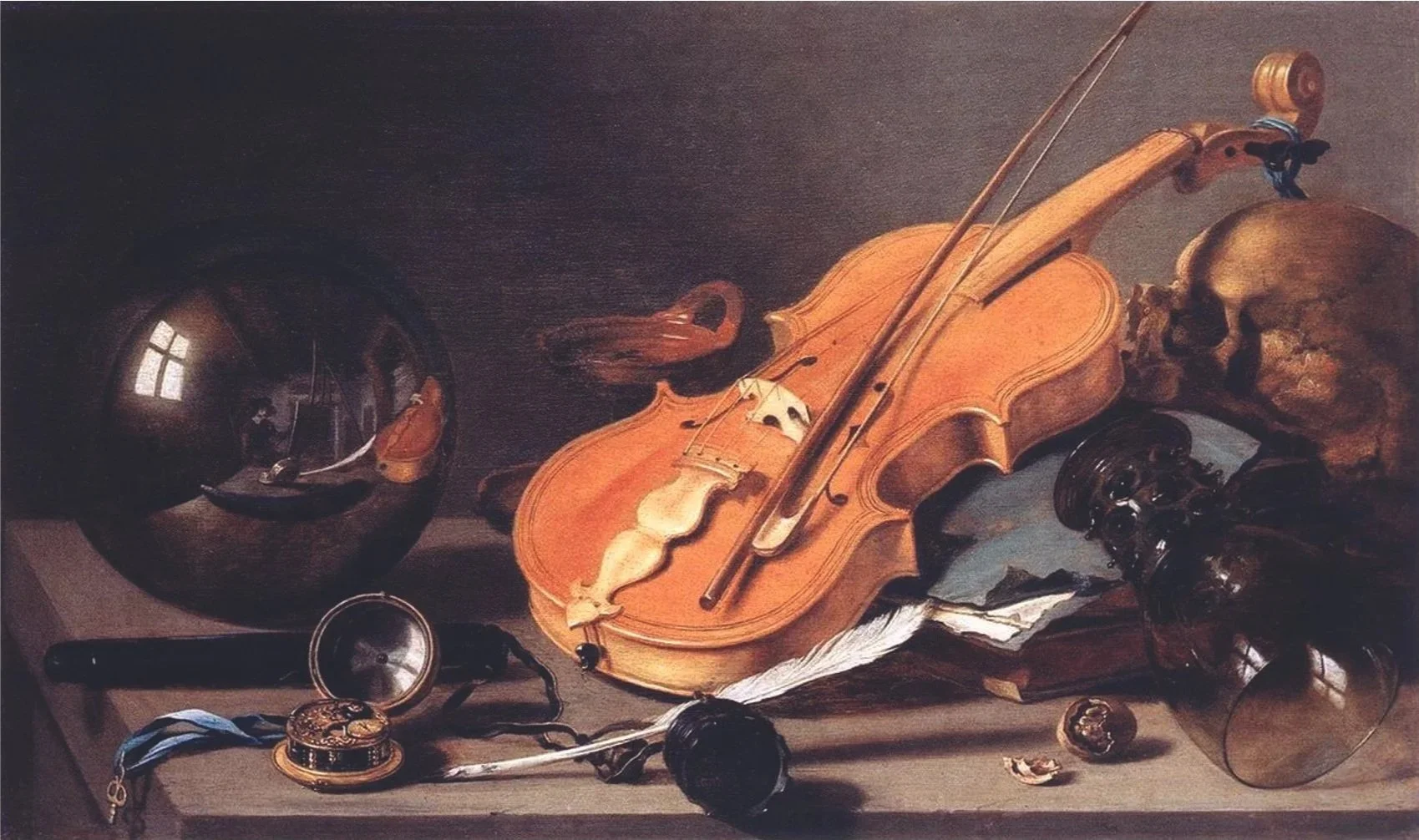
Claesz, Pieter, Still Life with a Violin and Glass Ball, oil on oak, 1625-1628, Germanisches National Museum, Nuremberg.
The objects in his study that viewers can observe collide with the mere reflection of elongated quills and contracted pocket watches. A sphere is without fault, as should be the teachings of the Catholic Church on death. Yet, the world within the sphere is misshapen, crudely preventing viewers from observing his real study, as are the Catholic and Protestant doctrine’s ambiguity surrounding the state of death.
In blurring the line between reality and reflection, Claesz parallels both the Church’s lack of definitive description for death — is it as simple as falling asleep? If so, do we truly experience death if it cannot be comprehended and one almost immediately awakens in the afterlife? Claesz is unable to offer any solutions in his work.
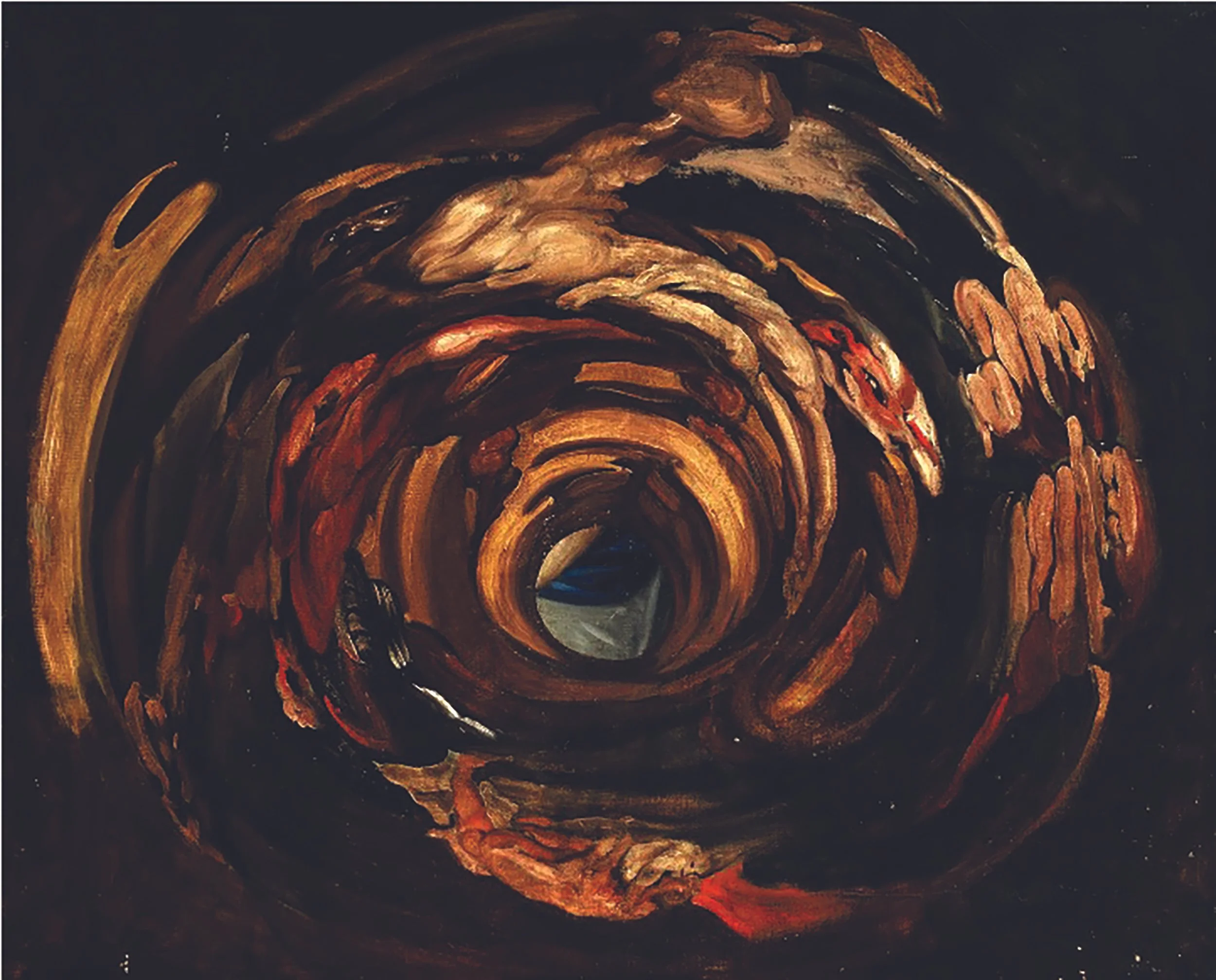
Piola, Domenico, Anamorphosis after Elevation on the Cross, circa 17th century, Rouen Museum of Fine Arts, Rouen.
By the time Piola had completed Anamorphosis, the artistic climate had shifted away from upholding mathematical rules for illustration, resulting in layers of physical abstraction being added to the act of perception. With potent doubt placed on Catholic institutions and the rise of Protestantism across Europe, notably Queen Elizabeth I’s reign in England, pre-established models of decoding divine truths, such as geometry, were challenged by a new order. Thus, Piola’s take on anamorphic technique veers into the extreme to embrace more radical representations of death and the soul.
Piola’s Anamorphosis is initially interpreted as a blur of colour, though the eye can faintly recognise limbs and torsos amongst the chaos. The uncanny effect evokes feelings of unease as the blatant disregard for linear sight forces the viewer into attempts of decoding the image. As shown in the image below these words, the painting requires a cylindrical convex mirror (mirrors curved outward to resemble a portion of a cylinder) to be placed at the centre to reveal an accurate reflection of Rubens’ Elevation of the Cross. Piola uses the mirror as an accomplice.
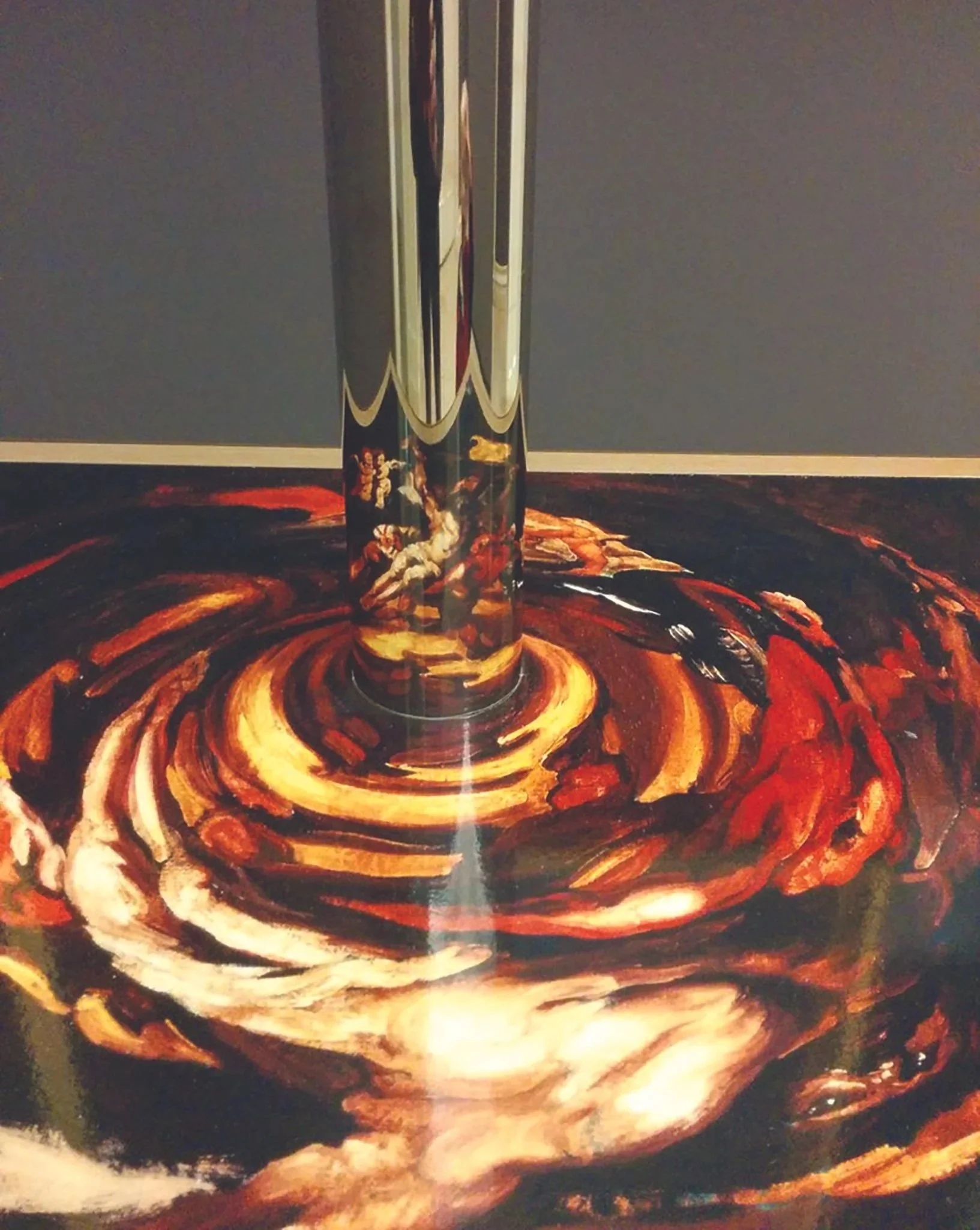
Anamorphosis after Elevation on the Cross as seen through a cylindrical convex mirror.
To decode Piola’s work, this external object is necessary. This dynamic acts as a microcosm surrounding mortal anxiety: external means of understanding death are deftly adhered to. Our perception of life and the afterlife can be informed through religious institutions and texts, but when those sources are no longer reliable, our perception of these things are no longer clear. Piola acknowledges the multiple interpretations of death put forward by opposing religious institutions, as they bounce off each other, inherently intertwined, yet fundamentally dismissive of the other. Yet, neither one is the most persuasive. In the case of elongated perspective, order and disorder do not appear at the same time; the images come in and out of proper focus as the viewer shifts position, symbolic of the lack of objectivity within religious teachings when pertaining to something as nebulous as death.
III
CONSEQUENCES FOR THE SOUL
Additionally, anamorphosis and distortion can be used to explore the dilemma surrounding the precise state of the soul during death and whether it survives before resurrection. Sleep, while close, is not an entirely adequate simile as the experience of death pervades the limits of the human imagination. Moreover, death is only transient. There is a contrast between words “natural” and “spiritual” to delineate between temporal life and eternal existence with God. This raises concerns for the matter of our souls’ survival during the state of death.
Holbein, Claesc and Piola’s artworks speak to this idea:
Holbein’s skull is straightforward in this respect. The formal flexibility to which one can view the skull affords it the similarity to the state of the soul; it is intact during life, but during death it is in an alternative, alien state, before returning to normal after resurrection.
Claesz’s self-portrait immediately informs the viewer that they are witnessing something slightly askew. The inclusion of Claesz’s self-portrait is a reckoning against still-life conventions as it introduces a human presence amongst the inanimate subject matter. The objects in the painting are reminders of the brevity of life: a skull and pocket watch forces us to acknowledge the unconquerable passage of time and a violin invites us to consider the short-lived nature of worldly arts and pleasures. But what is a more insurmountable reminder of mortality than a dead man? In the sphere’s reflection, Claesz’s dwarfed size denies the viewer from ascertaining whether Claesz is alive or has been reduced to a skeleton. Confined inside, Claesz is simultaneously living and dead, and his soul remains in limbo. Claesz’s distortion creates a space within the painting where mastery can never be asserted, as are the questions surrounding the soul during death.
When observing Piola’s catoptric anamorphosis, understanding the image as a recreation of Peter Paul Rubens’ Elevation of the Cross is important. As the original artwork is a Biblical narrative painting, we cannot divorce the moment within the painting from the entire narrative: as a painting of Christ’s crucifixion, Rubens’ Elevation of the Cross inherently embodies concerns for the soul’s division between life, death, and resurrection. Anamorphosis, without a convex mirror, is an incomprehensible circuitry of bodies that fails to draw any firm conclusions about Martin Luther’s thirteenth hypothesis. Through this, he expresses the futility in seeking answers to metaphysical quandaries. By including the mirror as a translator, it lurks “outside the painting… to suggest without showing.” However, it’s important to consider how the viewer’s position can heavily impact how they receive the reconstituted image. This imperfection is Piola’s subtle criticism of our attachment to external institutions to govern our very perception of death and the soul. Anamorphosis forces viewers to choose between two flawed methods of viewing the painting, as is the Renaissance man torn between Catholicism and Protestantism for guidance into the afterlife without receiving a firm description of what that might entail.
The Renaissance paintings by Holbein, Claesz, and Piola reflect a profound skepticism towards artworks relying on traditional ways of seeing. Ultimately, naturalist perspectives fall short in portraying the abstractness of death. By employing distortion and anamorphosis to convey the nebulous quality of mortality, Holbein, Claesz, and Piola each explore deeper themes tied to the power and unreliability of religious institutions in forming existential beliefs, the extent of geometry as a divine tool, and ultimately, the inscrutability of death.
To rebut Bazin’s condemnation of perspective, it is these artists’ readiness to manipulate perspective that allows us not to see what lies beyond life, but resonate with it in a way that transcends sight.
