
In dialogue with trent newman: on language, power and identity
Interview by Freja Newman.
Right at this moment, I don’t understand what it means to love in another language. I hope to someday. My uncle, an applied linguist and a lover of language as well as in language, has told me stories of building and maintaining whole relationships in languages other than English and the idea fascinates me…or perhaps it’s envy. Either way, I decided to ask him about it.
Communicating vulnerability and emotional upheaval seems to me difficult enough in one’s first language. I can hardly imagine trying to tell someone my heart is breaking in language that isn’t mine, that feels foreign in my mouth, and that is fractured and not fully formed. I can’t imagine presenting an incomplete version of what I feel and what I want to communicate to a person who I care about deeply.
Language and dialogue are messy and incomplete, even when they’re carefully stitched together and pre-planned. We’re immersed in language in so many ways beyond what we habitually notice - not just through our speech, but also through our history, our signs, our bodies, and our relationships. As my uncle explains, we are always populated with the words of others, and every word ‘tastes’ of a genre, a generation, a place and a time.
This interview, in true dialogic form, will be messy. Even my attempt to construct coherence on this page is a language in and of itself. Transcription in the linguistic sense is the systematic representation of spoken language in written form. It is a language in and of itself. How does one represent intonation or pauses? This conversation was built upon ‘likes’ and ‘ums’ and ‘hmmms’ and ‘okays’, the majority of which will be erased for aesthetics and comprehension. I’m not removing myself or my uncle’s voice or opinion. But perhaps, in a way, I am. You can trust that the words on this page were spoken, but perhaps be aware that the syntax and structure has shifted to accommodate for the written form. However, like any piece of writing, I hope you will also trust your reaction to it and whatever instinct and thought it evokes. As you read this, know that we, too, are now in dialogue, in the meta-sense. Yes, roll your eyes if you must. Let it all out so that you can best translate this transcription. No one is forcing you to engage in this conversation, but I hope that you do.
Language embodies us at a visceral level.
We make sense of the world and our experience in it in and through dialogue with others. We use language to build relationships and to talk about these relationships as we are building them. It’s quite a feat to step out of language and observe ourselves in it. In not seeing ‘the forest’ for ‘the trees’, the immensity of language and its centrality to our very existence as social animals can go unnoticed and, more problematically, unquestioned. Language overlays and underlies everything, and yet is hidden. In this dialogue between my uncle and I, we try to unveil it and see it more clearly.
Language overlays and underlies everything, and yet is hidden.
F: You asked me to read up on the term, ‘heteroglossia’, coined by the 20th century Russian philosopher Mikhail Bakhtin, before this interview. What is so interesting and relevant about his work when looking at how language exists today?
T: His main work is called, ‘The Dialogic Imagination’, which is an interesting and powerful title, but he writes a lot about fiction and narrative. He draws implications when thinking about narrative texts for how we as humans operate as narrative beings. So, ‘narrative and dialogue’ are key concepts, but so is the concept of voice, which is connected to that word, ‘heteroglossia’. ‘To gloss’ something in linguistics is to sort of say it and to utter it. Heteroglossia (which is not, I think, his original term in Russian but just how it’s been translated, which is interesting in itself) is understood to mean that whenever we speak, because language is a thing that we exchange, that always has a history, we have learned our voice through being socialised and through previous conversations. He says in this beautiful way that “our words are always populated with the words of others.” He says that “every word tastes of a profession, an agenda, a day, a time.” Words bring things with them. We have this word in English, ‘connotation’, which starts to get to it, but that more speaks to the associations we make with words. Bakhtin is talking more about, especially using that word taste, how as we bring these histories into our mouths to produce words, there’s almost this embodiment that affects us at this visceral level. I find that idea really powerful.
“our words are always populated with the words of others...
...Words bring things with them.”
F: What are the consequences of the power language yields and constructs in our world today?
T: Language is something that we take for granted, which I find fascinating, but also somewhat troubling, particularly in our current era when we have untruths; untruths presented as truth and taken to extremes. Whole communities and populations can be kept in situations of violence because of language. The protracted conflict in Israel/Palestine is, I think in many ways, just the epitome of that. The chief way everyone talks about how Israel maintains its power is through the weapons they have that the United States and Australia continue to help supply, and certainly yes, there is that direct force. But one of the chief ways Israel maintains its power is through language, and the media and all sorts of significant powers in the world fall in line. And this all happens in and through language. This is done, for example, by resisting Palestine being called Palestine. It’s revealing just paying attention to where and how Palestine gets called Palestine or something else, like Gaza and the West Bank as separate entities. Even just paying attention to when people talk about racism and anti-Semitism as though anti-Semitism is something distinct that needs a separate category. This carving out of a particular type of racism has happened over time discursively, and is still used as an argument by Israel at the United Nations whenever anyone tries to oppose their building of new settlements.
“...untruths presented as truth and taken to extremes.”
T: Power is all too often, I think, thought of as something that one person has and another person doesn’t have, or it’s a thing that gets taken away or given.
“But power is negotiated in and through language as so many things are.”
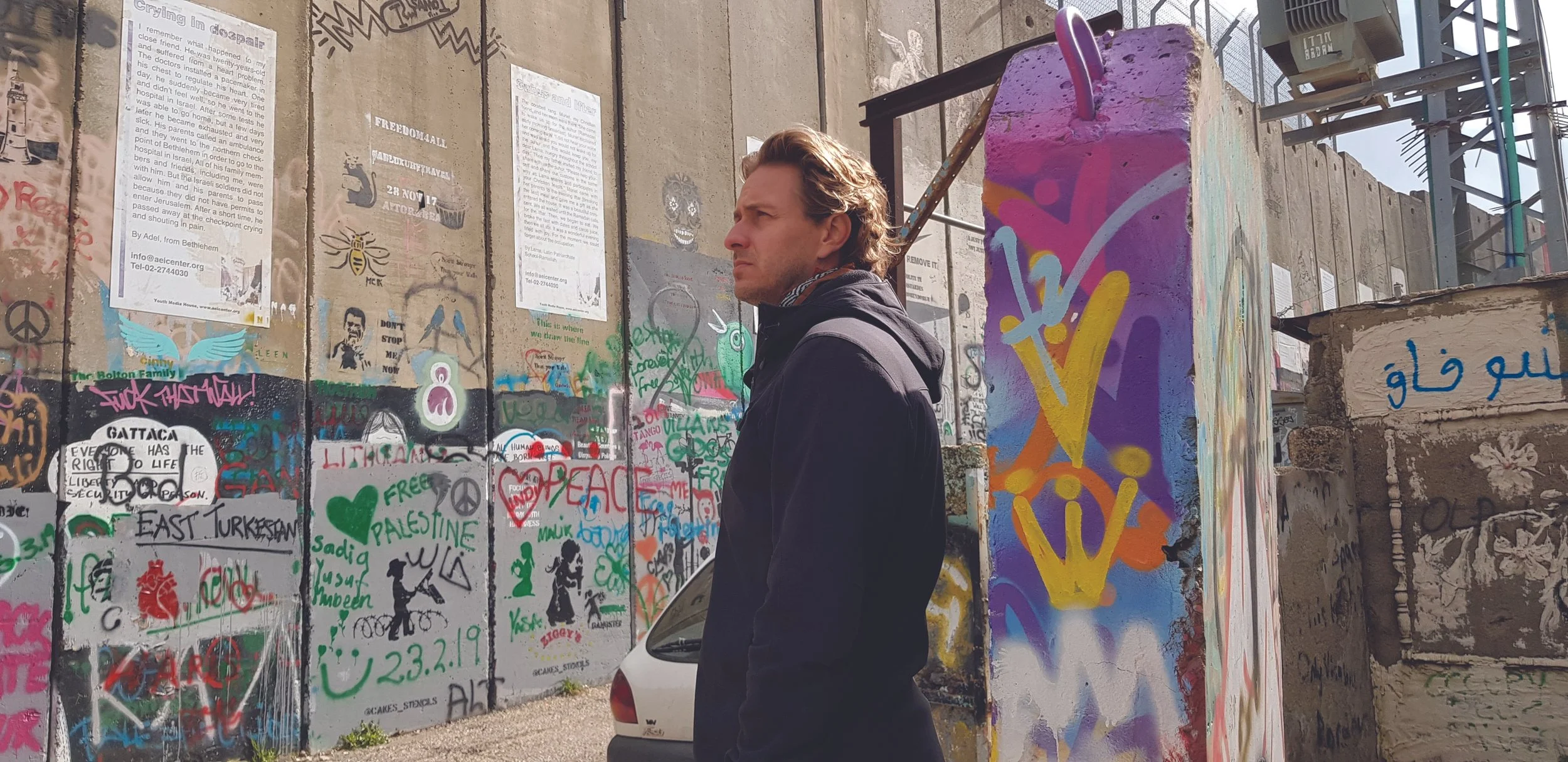
Trent in Bethlehem in 2019 on the Palestinian side of Israel’s separation wall which began construction in 2002, slicing through Palestinian communities, agricultural fields, and farmland at the height of the second Intifada.
F: You mentioned before that our words are populated by our histories, time, and the words of others, all things that ebb and flow. What role does language play in the construction of identity or the self?
T: Unfortunately, there’s still a strong trend in linguistics, particularly in studies of language learning, to focus on the form and structure of language, grammar, pronunciation, and so on, and to view it as somehow existing separate from the humans that use it and wield it. However, in learning other languages and having relationships in other languages in the past, I remember feeling a different sense of who I am when speaking that language. People often talk about how when you dream in another language, that’s when you know you’re really fluent, which I think is an interesting idea to unpack. But I think fluency or even learning another language is about seeing yourself as a different kind of self. When you have another language, another linguistic system, you have different ways to present the self with a different voice.
F: How have these different selves manifested in your personal life as you’ve navigated romantic relationships in languages other than English?
T: I guess, on a personal level, the example that comes to mind when I’m talking about all of this is when I had a relationship with a Colombian guy who was on a working holiday visa in Australia when I was in my early 20s. His English was good, but I feel like, at the time, my Spanish was just a bit better than his English, so we would sort of default into Spanish. So, during our relationship, we would have a lot of our conversations about how the relationship was going and even fights in Spanish. I remember at the time thinking that this was really pushing my language capabilities more than studying advanced Spanish grammar at university ever did because I was having to not only think about how to articulate my feelings, but also figure out how to respond to this other person’s feelings. This speaks to a broader point about the kind of language learning that happens when you’re using it to construct meaning and build relationships, which is basically what language is for.
In terms of the way another language sort of makes me feel, when I first started learning Spanish in Peru and then as I got better through relationships with this Columbian guy and others, it was, and I’m hesitating to say this, but I felt like I was connected to a more passionate ‘Trent’. I felt like it birthed, in a way, a more passionate, fiery Trent. It’s not just the language there, as language and culture are so intimately connected, and so it was the whole experience I had of living in Peru. And then I think about the Japanese language and living in Japan. When I speak Japanese, I’m instantly connected to a sense that I have of Japanese culture which I associate strongly with Shintoism, so, there’s more of a sort of spiritual side to that ‘self’ I’m presenting in and through Japanese.

Trent in 1997 at Chavin de Huántar, Peru.
The reason I hesitated when I was starting to talk about Spanish birthing a more passionate and firey Trent, is that I’m not completely sure yet about this idea. I’m still trying to think through whether I think this is because of existing stereotypes about the language that I have learned or that I brought with me to the language learning, or whether there is something about the language and culture that just sort of lends itself to a bit more heart-on-sleeve, earnest and poetic styles of speech and communication. I think there’s something to that. I think there’s also something to an analysis of English as quite a cynical language and a language that now, with centuries of colonialism and globalisation, has dulled or blunted its metaphoric and poetic utilities.
F: I think it’s so interesting to hear these stories because you’re communicating almost a multitude of lives that you’ve lived that, while different, have pieced together one life. While you were ‘you’ at every point, every life, and every language, you also had a different sense of self as you mentioned. And there’s a beauty and challenge in reflecting on that too. In my learning of French and words here and there from other languages, I find I’ve always been drawn to those words deemed untranslatable. There are so many phrases, descriptions, feelings, and instances that exist in so many different languages that can never be truly, exactly translated because there is a history and a culture and a social existence that accompanies that. Thinking about this, it makes you wonder how a word for a concept emerges.
T: A word emerges because there is already a sense or a feeling that begs description or begs labelling. So, that’s why I think these untranslatable words are so particularly beautiful. These concepts and feelings, these ideas like wabi-sabi (侘勘寂勘) in Japanese, which, translated, means there is beauty in things being broken and imperfect, had to emerge culturally and socially. This is the same for the term ‘nyokinyoki’ (刈款鰍刈款鰍), which is both onomatopoeia for the sound of things growing and an adverb, meaning ‘sprouting’ or ‘popping up all over the place’. The idea broadly that things that humans can’t hear still have sounds had to exist before the word got coined. And I love that and it gives me hope somehow.
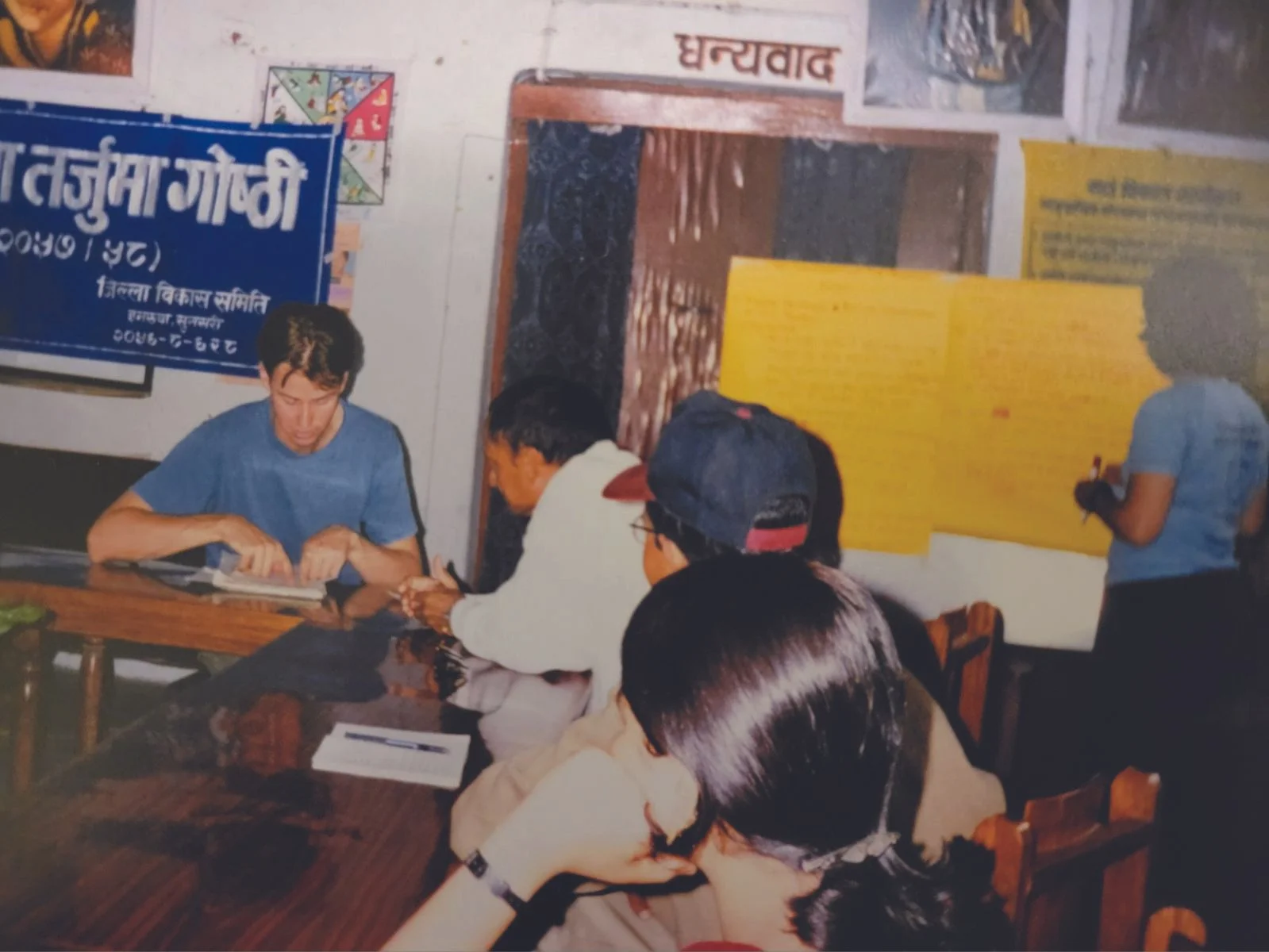
Trent in south-eastern Nepal, 1999, sharing observations with the local Village Development Programme coordinators after volunteering with the United Nations Development Programme. The man wearing white was Trent and his partner’s translator.
I’d also like to ask you a question if that’s okay? In relation to the point about the presence of multiple languages even when we think we are monolingual, I wanted to ask you, even though you feel you haven’t yet had that opportunity to feel like a whole different kind of self in French, for instance, do you not, though, feel it in English when you present different ‘Englishes’ in different contexts, with different audiences? Are you not presenting different kinds of selves there?
F: Oh I definitely think I present different selves, but perhaps, before this conversation, I never associated that with a different language I was speaking. It was exhibiting a different kind of communication, which although knowing this to be an aspect of language, was never something I connected explicitly.
Also, now just connecting this to what you spoke about with heteroglossia, I think positioning myself in a narrative where my voice and words taste of different professions, identities, times, and places is interesting and also plays a part. I often joke about not letting my different personalities mix in social settings, but it’s not like I’m a completely different person. There is still a throughline. I’m still myself, but there’s just different levels of transparency or vulnerability that perhaps I reveal to different people based on either our experiences together or what they present back to me. And that’s not a negative thing at all, because I think everyone does it.
And I connect this idea to the way in which we relate to certain people. Sometimes you can feel an innate connection to someone for some reason, even if you’ve just met. Sometimes you can only reach a certain point with someone you may have known your whole life. And so, when I’ve met those people that I’ve felt instantly connected to, it’s not an overwhelming feeling that emerges but a relief. I think to myself, “Thank goodness! How beautiful is this! How did I get so lucky?”
T: Well, lately I’ve been thinking a lot about dialogue partners. Because I think that’s what allows that connection that you were talking about to happen. In the space–in this dialogic space–that gets created when you’re talking with someone and they’re talking back to you, it’s interesting how you can recognise yourself in what they’re saying or how they’re reflecting back to you what they’ve understood you to say. You’re building something dialogically. You’re building meaning together.
And that can happen when you first meet someone and all sorts of things go into that, like your mood at the time, your inhibitions, the effects of something in your system like alcohol, the context, your perception of them, etc. And this says something about how more than just words speak; context speaks, clothing and how we present ourselves in all kinds of ways speaks, skin colour speaks, gender certainly speaks. What are the forms of language and even styles of communication and speech that we carry across different communication contexts? For instance, whether you’re talking to me, to a friend, to an elder, or giving a formal presentation, I’d be interested to sort of observe what styles of speech are carried across all of those.
How do you present yourself as a gendered person? How do you present yourself as of a certain generation?
Whilst we are heteroglossic and we do present ourselves in different ways, in different contexts, using different linguistic forms and styles, there are some threads that carry across that are also not necessarily conscious. There’s some connection we have that helps us maintain that sense of core identity. Even when learning an entirely different linguistic system, I feel, in my experience, drawn to certain aspects of language that feel comfortable. You find terms of speech that feel nice to present.
The kinds of people for whom this kind of awareness of language comes more readily, not necessarily easily, but more readily, are often people who are marginalised by it in some way. So, feminist movements have drawn attention to how ‘men’ is used as the default when talking about humans. More recently, the trans and non-binary movement drawing attention to gender in language is another example.
T: That awareness and the resistance to norms that are problematic comes because there’s an experience for these people of being marginalised through language or being positioned in a way, in and through language, that they don’t identify with. So, what they need to do is to break out of that and to find other available subjectivities, other possibilities for expression of the self in and through language, of which pronouns is one. And so, the people that are the most secure in that status quo language situation are often the ones that have the most trouble with challenging or changing it. You hear people ask, ‘why do I have to learn everybody’s pronouns?’ like it’s a personal inconvenience to them. And they don’t get it because their identity is so comfortable, so reinforced by the dominant ways of representing ‘self and other’ in language, and they have a vested interest in keeping things that way.
So, the way that this all plays out, this tension in identities, is also something that language has to somehow accommodate. It’s the tool through which we can move through it, but it’s also the field in which the tensions are playing out. That’s tricky in itself, that language is doing both at the same time.
F: When thinking about these ideas and the notion of finding comfort, beauty and connection in other languages, in second or third languages, it’s also made me think about what it means to find identity for those who have lost their language, who have been forced to forget or had their language silenced and marginalised through social or cultural assimilation. What does it mean for second or third generation migrants to be taught the native language of their culture in adulthood, after going so long without it? What does it mean for trans or non-binary people who have a sense of self and identity that for so long, through language, they weren’t allowed to communicate? Now, what’s left is either to reclaim or reconstruct their language and their expression of self. Those who have never been marginalised through language complain about the discomfort of having to change, but imagine being born uncomfortable and living your life not knowing how to express why.
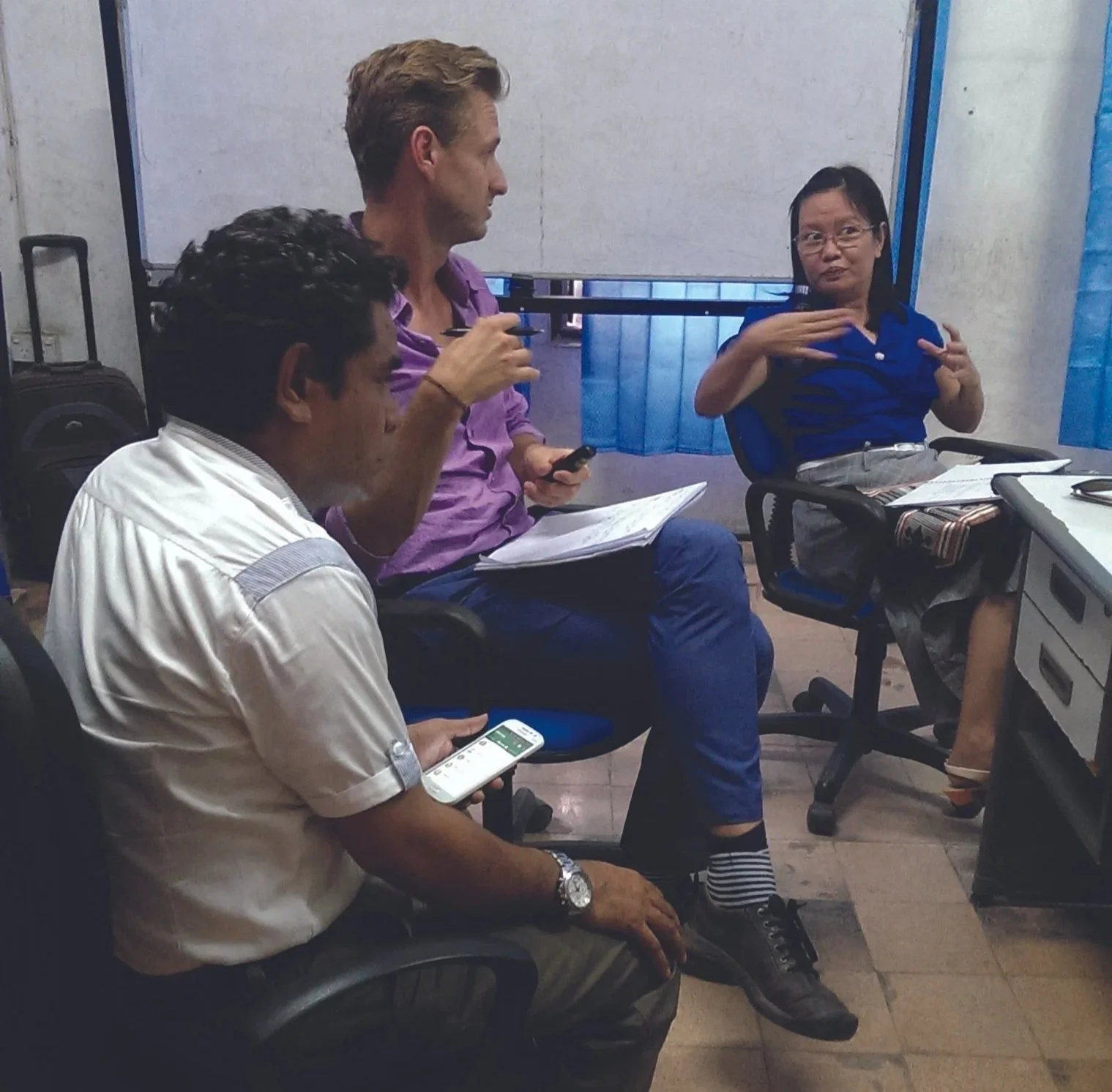
Trent sharing research findings with community development educators at the national university in Timor-Leste.
T: Making that connection to minority languages or languages that are in processes of revitalisation is an interesting connection, because I think immediately of Aboriginal and Torres Strait Islander peoples. I’m doing a research project at the moment that’s looking at Indigenous languages teaching in Australia, in the context of languages education more broadly nationwide. In the southeast, there’s much more of a situation where it’s language revitalisation that’s occurring. In many cases, because of colonisation and the ongoing hegemony of English (and a certain kind of English, by the way), there are many communities where there aren’t really expert speakers of what has been their traditional language. Who is an authority on any language when the language is in a process of revitalization? That’s a really tricky question. And then there are other communities, particularly in the north and the west of Australia, where there has been more of a continuous use of the languages that exist and where there are elders who are considered the custodians of the language to pass this knowledge on. But then there’s the question of how to work with these elders who value traditional forms and uses of their language when the language is also constantly evolving and in a state of flux, as there’s younger generations who are using these languages, but also mixing it with English, creating new and hybrid forms of language, reflecting their hybrid identities in this postcolonial space.
F: You began to touch on this, but given your background and practice in pedagogy and education, how do these marginalisations of the self and identity through language manifest in educational contexts?
T: When we have a system, not just in Australia but worldwide really, of educating people that is really based on comparing and assessing quantitatively, that doesn’t allow for the kinds of thinking, teaching, and learning of language that we’re talking about.
Unpacking the relationship between language and identity, as we have been doing, requires this complex, sociolinguistic lens in order to see how identity is something that is actually produced in and through language, from moment to moment, utterance to utterance.
Identity can be, in certain contexts, affirmed through language in dialogue or community with others that have shared values or a shared sort of identity. However, in other contexts, which may be the dominant culture, and particularly in schooling, there are certain ways of speech and even whole linguistic systems, like forms of English, that are prioritised while other languages are marginalised.
The relationship between minority languages and identity is very important, as well as between these languages and formal schooling and what that does to people's sense of their own competency.
In schooling systems, that’s where you get told whether you’re a competent social being and whether you are going to be able to make a living and get a profession. That’s also where you get told that you need to speak this one type of language, that you’re going to be assessed on it, and that there’s not going to be any space for you to speak the language that you had your first and most formative relationships in. There’s no space for your mother tongue, or the multiple languages you may speak at home, or any other language that may exist in your community.
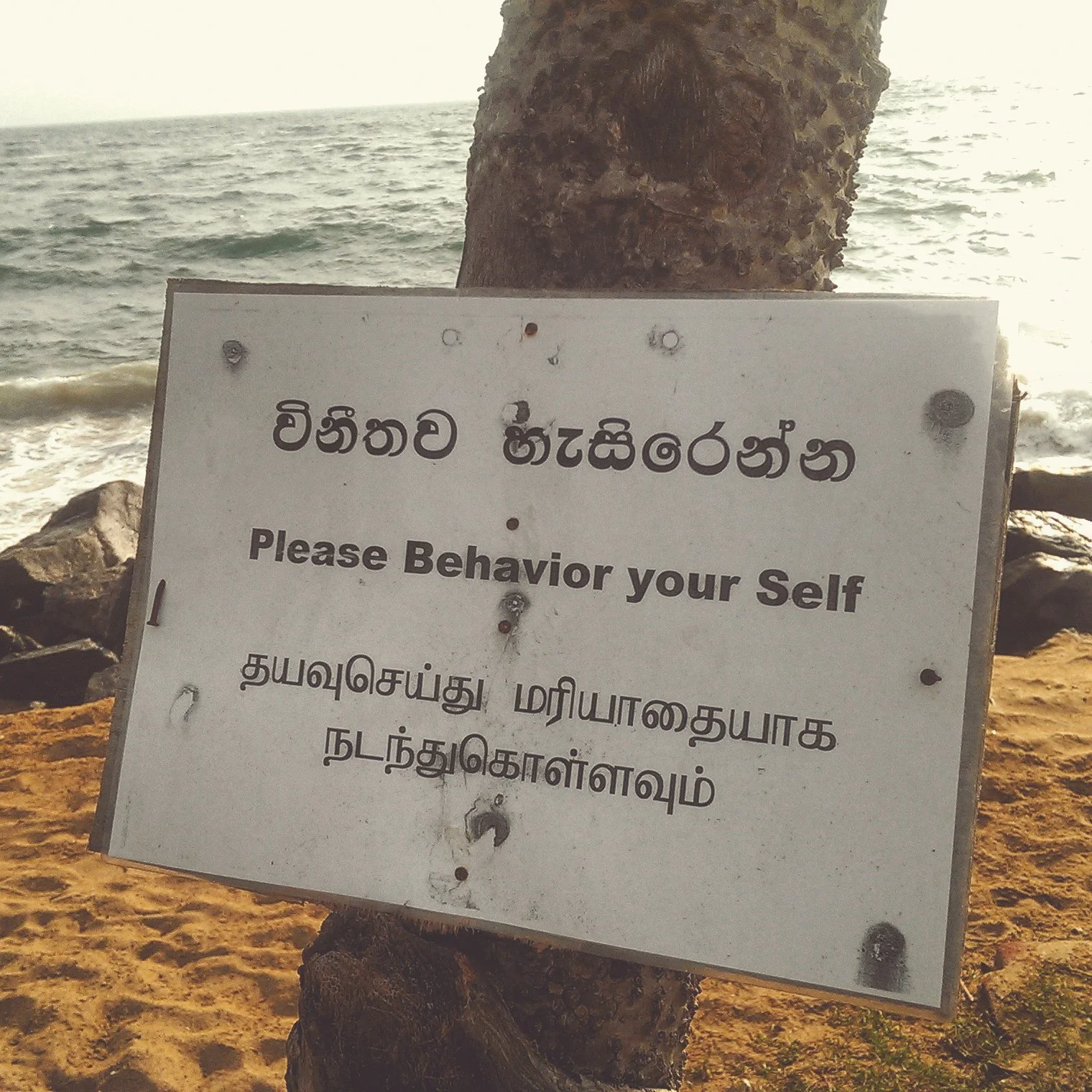
Sign appears in Sinhalese, English, and Tamil on the east coast of Sri Lanka, 2015.
F: To bring it back to Bakhtin, how does his concept of heteroglossia exist in multilingual education?
T: The term has been used more and more in multilingual research, particularly multilingual education; thinking about how multilingual learners learn and how to do multilingual education. By bearing that concept of heteroglossia in mind when you’re talking about multiple languages in the classroom, it’s not just asking, “are there Chinese students or Spanish students that are speaking those languages while you’re trying to teach in English?” That’s a very outdated and a sort of ‘language-as-national-language’ way of thinking about things.
Thinking about multilingual education in terms of heteroglossia means that every classroom is multilingual in a sense, because we’re all bringing in our own idiolect.
We’re all bringing in our own ways of speaking that are populated and influenced by diverse voices.
We are all presenting different selves and seeing different versions of ourselves in the stories, signs, relationships and past we interact with and hold.
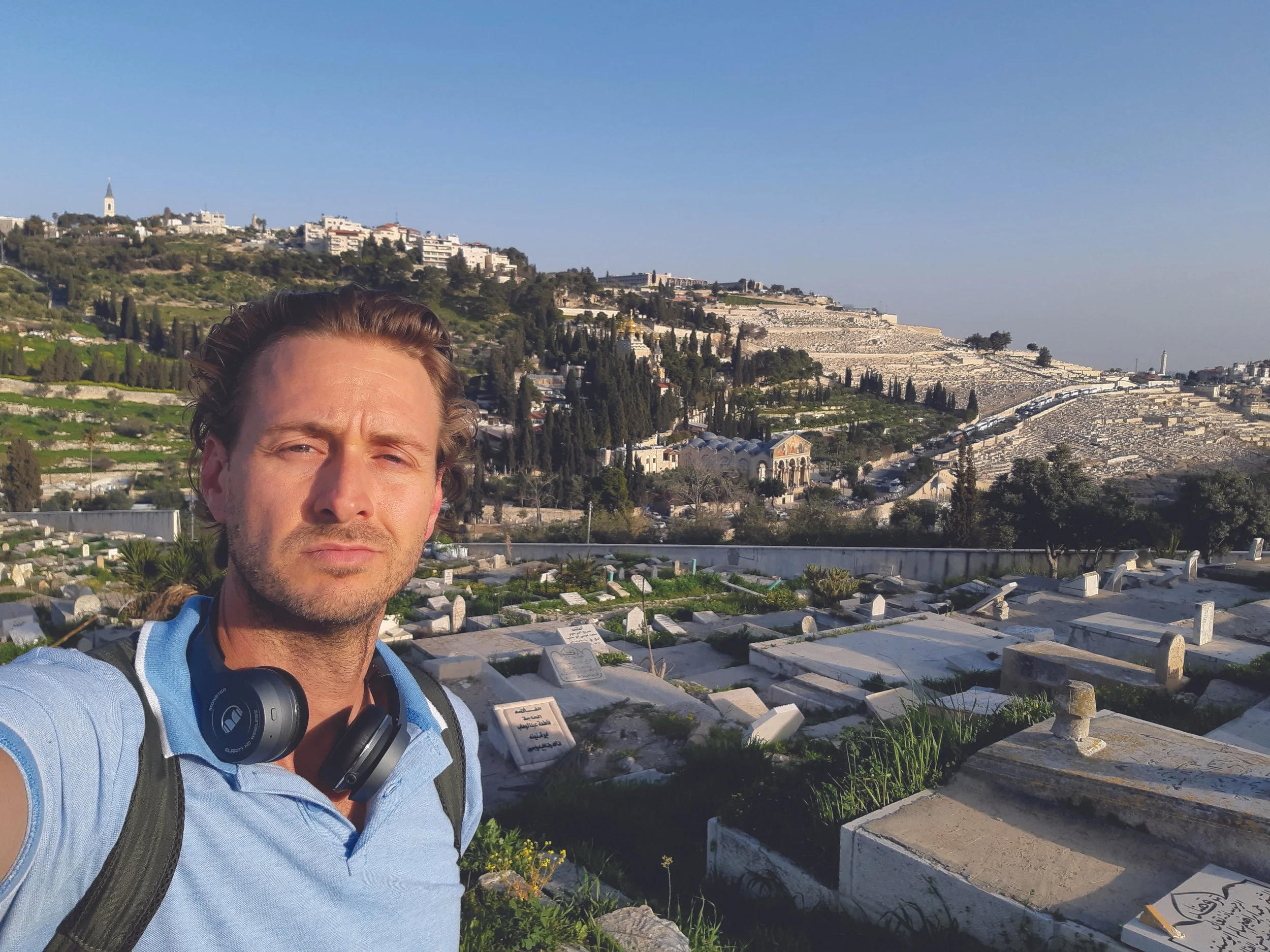
Trent outside the walls of Jerusalem’s old city in 2019. The Mount of Olives can be seen behind him.
Dr Trent Newman is an applied linguist and educator with a doctorate in multilingual education and critical sociolinguistics from the University of Melbourne, and a masters in social and cultural studies in education from the University of California, Berkeley. He has been professionally engaged in some way with the broad area of language in education for close to 25 years, although his career didn’t start in linguistics. He’s researched, taught, and worked in international development, human rights education, peace education, language policy analysis, language translation, and intercultural awareness.
He confides to me that he’s also found himself cleaning toilets in an Irish bar in Alsace, France, after following his French-Japanese lover there…because, sometimes, we do things for love that we don’t expect of ourselves. That relationship, he says, was navigated in a mix of Japanese, French and English, and ended with a kiss in the snow in Sarajevo, Bosnia and Herzegovina.
He now lives on a small farm in South Gippsland, Victoria, Australia, with his husband, their two dogs, and various other animals. He continues to seek out opportunities to learn and grow in and through dialogue with others every chance that he can get, in whatever language may be available at the time.
