Welcome to the Past
By Carson Coffey
In order to get to the past, you must first leave the present; the confines of a city and the preconceived notions of what is today and will be tomorrow. The past is all about an idea of now, no vertical thinking. The past challenges you to believe in words you’ve already read, be it through the history books or the scars strewn about your body. Divots of quips, caverns of anecdotes, and sprawling valleys of stories that play in your mind’s theater every night.
After you’ve stripped off the layers of now, an orange pink sunset, like those you used to admire with your sister growing up, guides you to the time machine—an old, beat-up manual-transmission minivan with a shapeshifting angel, or a polyglot in a white dress. Take your pick. In the time machine, smelling of attic boxes, you may begin the process of forgetting. Start with the future. Unencumber your worries, the lack of passion, the always reaching, never floating, always sinking, never drowning. Now, the White Dress aids in this process, though you must still climb the mountain alone. She tells stories from her present, which appear to you as past. You hear of innovative music whose influence came from the last, and when she’s entranced you with each seam and hem of her life’s white dress, you realize you’ve been driven to the point of forgetting where you just came from. You look over and notice the same about her. She seems to be guided only by distant childhood memories. ‘Drive straight past her school, right at her old friend’s house, and left at the street corner where she had her first kiss, until you hear the faint hum of a backyard zoo slowly amplifying until a symphony arises.’ At least, that’s how she introduces it, though your ear is not refined enough yet to pick out the winds from the strings from the horns. Right now, it’s still cacophony.
A rustic wooden gate marks the entrance; its splintering wood, makeshift repair work, and injury-laden history lend it the name “Gate of Hell.” She shows you why as well, a gash on her toe just out of reach from ruining the white dress. You meet the symphony’s top contributors, a first-chair canine and a riotous swine ripping a solo. The music will go on late into the night, with all of Romania’s top jazz musicians swapping in and out as they need rest. It’s like nothing you’ve experienced before, and all at the cheap price of abandoning expectations.
You lay your eyes on the palace of the past. An eighteenth-century mansion built by a baron. Upon entering the mansion, you find antiquity blended with modern routine. White Dress’ four-year-old daughter lies watching television in a room the baron may have once used as a drawing room. There’s a small bedroom on the left, perhaps the old servant’s quarters. You follow White Dress into the kitchen to find her mother, who, if not for the language barrier, would likely share stories and ask for yours. Instead, her stories come in the form of homestyle Romanian cooking. A sheep victim to the necessity of life, the plum’s underrated ability to craft a liquor beloved by a nation. You meet White Dress’ husband, an Irishman, who teaches you that being out of place is right where you need to be. Then you met her old flame and current bandmate. You wonder how they all make it work in one household. Yet, they do. You debate with her bandmate about the creation of music. He argues that the animals only learned such melodies from each other. You believe everything that makes up music, and all art for that matter, is a lake distant from the spring; yes, its influence is still felt, but the lake remains separate. He counters that it was the stream which connected the spring and the lake that is to blame for the symphony outside.
After you question why that is, he posits that the rustling water battered the rocks and taught the birds to carry a tune, a tune that then taught the others. You’re still ignorant to the complex chord progressions of life, yet you pretend 22 years has been enough time to learn. But that’s why you’re here, to learn that you know nothing. The Irishman sees you’re making a fool of yourself in the dinnertime discourse and offers to join him in witnessing his mother-in-law’s goat milking expertise. You’re promised to try it yourself the following day. It won’t go well, but in a still photograph, intent reigns supreme. That night, you sleep in a bed that aches of time and smells like the couch your grandma would read to you on. You sleep well in the nostalgic cocoon, getting lost in the cul-de-sacs and crevasses of your mind’s theater.
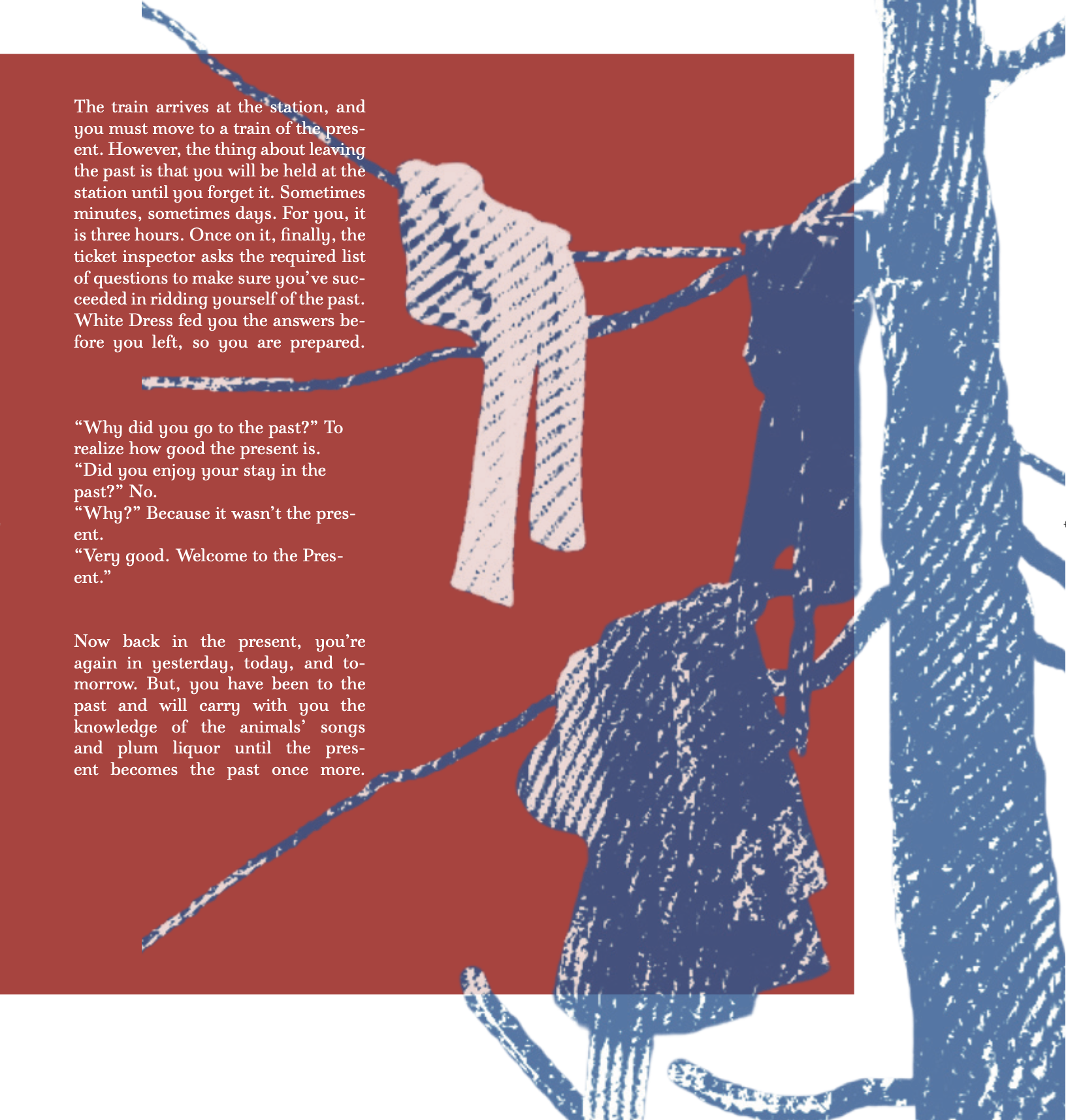
You’re awoken to the tuning of instruments. The symphony has new scores to play when night turns to day, geese now join in on an improvised ditty, and White Dress’ mom has made breakfast; goat cheese crafted from the spoils of last night’s milking, tomatoes picked from the garden, everything fresh. After breakfast, you clean your clothes, which reek of a distant version of yourself—one with incessant dreams and knots in your neck that never fully get worked out. You hang the clothes on trees out back; the wind here is as strong as the great Lethe. The rest of your time goes by with more shots of plum liquor, feeding the animals, and wading in the river out back. Until, at last, the symphony’s finale. It starts with soft howls, and eventually builds to a chicken, one of the finest in the wind section, crooning a passionate lament. You’ve now learned the melodies of the animals and know this one to be the song of goodbyes. It’s time for you to return to what once was familiar.
In order to return to the present, you must venture to the train station that has been worn down from the constant pulling between past and present. White Dress insists on driving you, and her mom has packed you a breakfast. Their generosity knows no bounds. For you, this is one of the most foreign aspects of the past. White Dress leaves you in the darkness, though, because of the inscribed bag she gave you to hold the breakfast, you will never truly forget the past.
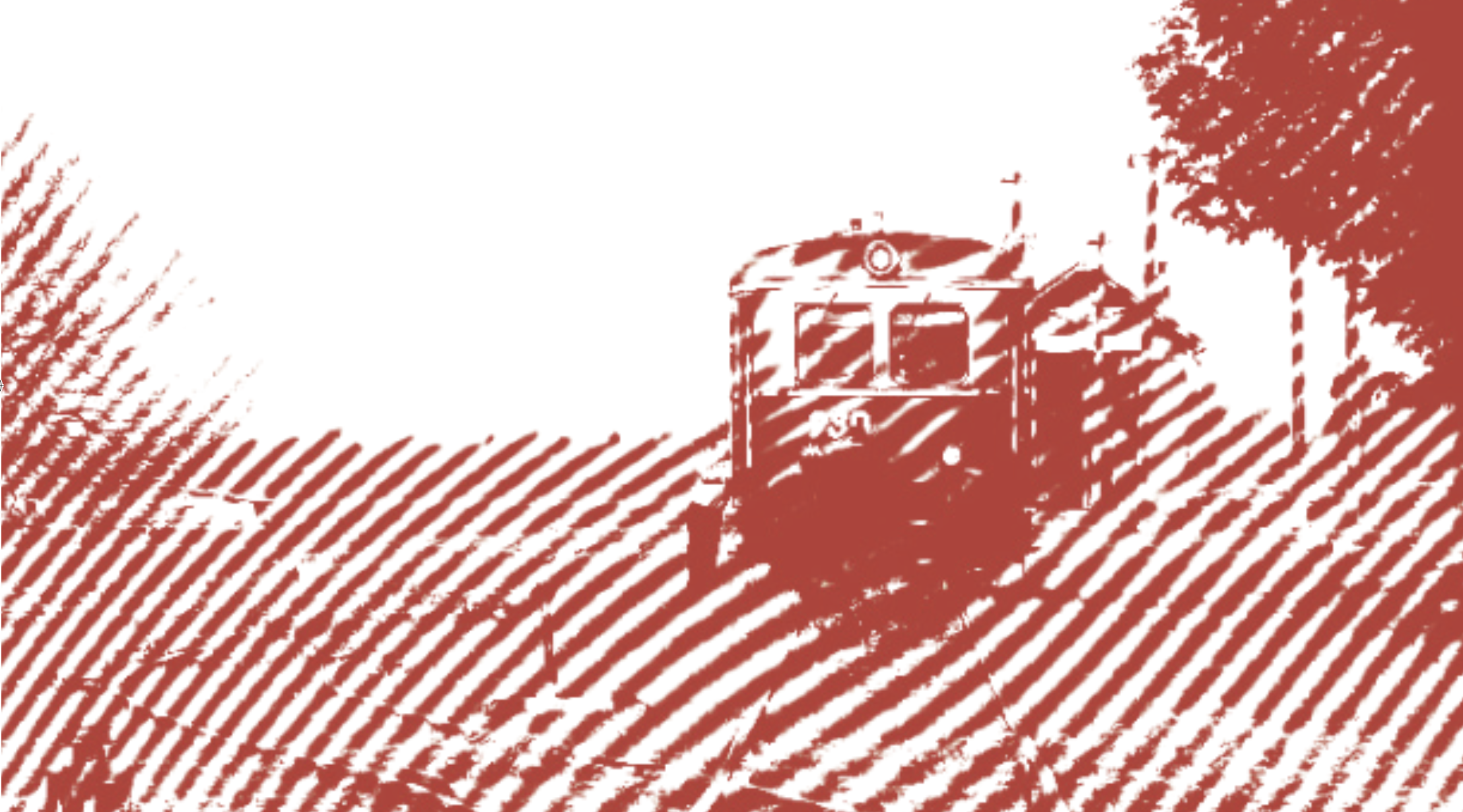
Once alone, you must board another time machine: the train that arrives through the fog. The seats of the train remind you suddenly of the bus you once rode on the way to and from school, and just like that bus ride, the fog train rocks you back and forth, jostling the memories of the present back into you. The fog seeps into the cabin, or people are smoking, you’re too preoccupied with remembering to determine which it is. The first memories that return are those deeply embedded inside you, the ones that fundamentally make up who you are. Given that you are now changed, however, some of these are left in the haze of the fog train. The next are the memories of the people you love and who love you. You feel a stranger to them now. As you look out the window of the slowest train in the world, you catch eyes with that stranger.